
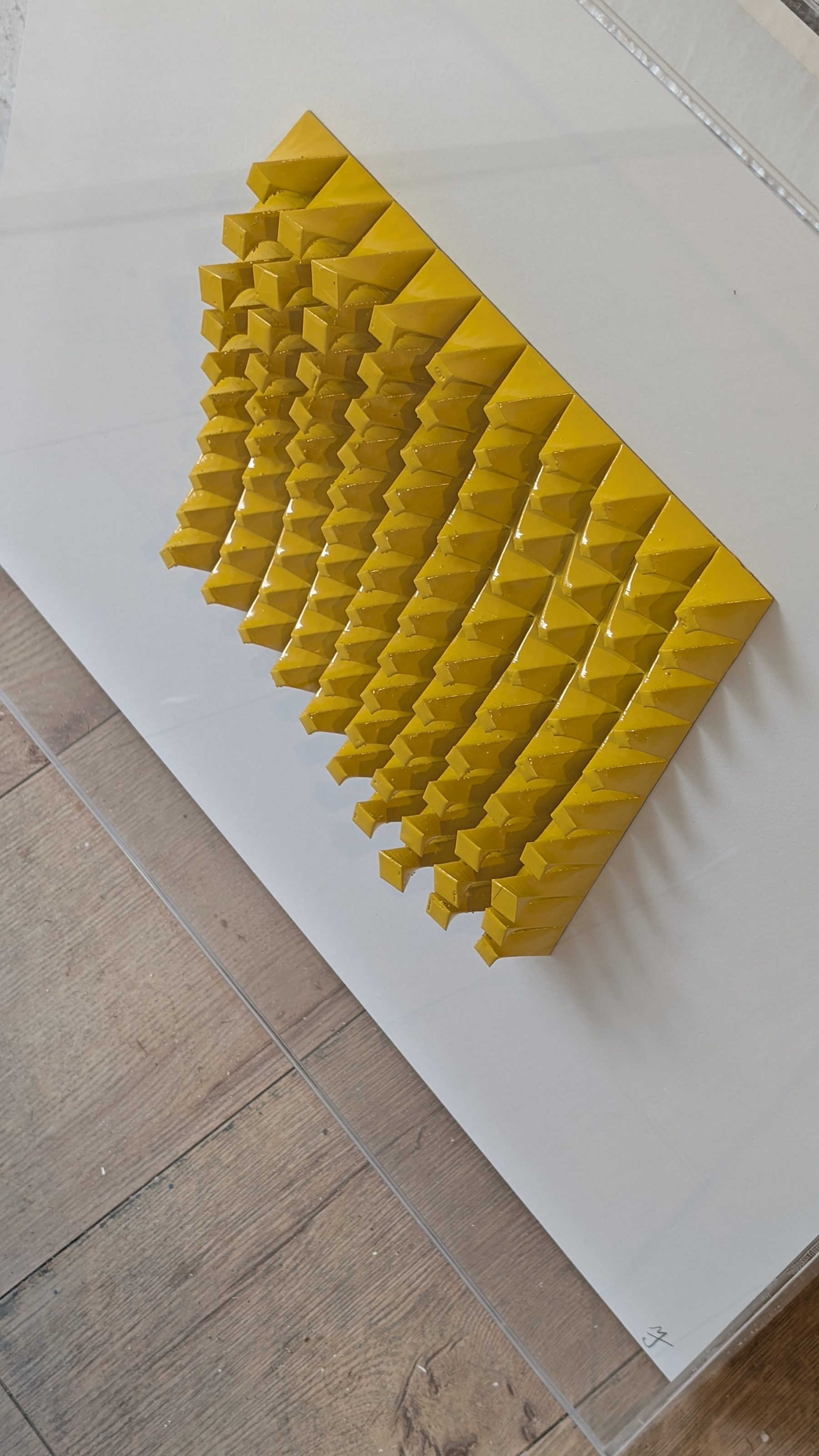
El punto de partida es un objeto doméstico, el tablero de encaje de un juguete de infancia, donde una superficie regular ordena el espacio en unidades idénticas y disponibles. Sobre esa lógica el artista dispone un módulo piramidal repetido cientos de veces dentro de un cuadrado de cuarenta por cuarenta centímetros, cuya altura no responde al azar del armado sino a un campo continuo que recorre el plano, levanta unas piezas y hunde otras. La retícula permanece intacta, la onda la atraviesa sin romperla, y de ese desajuste entre la grilla y el flujo aparece la forma.
The starting point is a domestic object, the interlocking baseplate of a childhood toy, where a regular surface organises space into identical, available units. On that logic the artist arranges a pyramidal module repeated hundreds of times within a forty by forty centimetre square, its height answering not to the chance of assembly but to a continuous field that travels across the plane, lifting some pieces and sinking others. The grid remains intact, the wave crosses it without breaking it, and form emerges from that mismatch between lattice and flow.
El bioplástico recibe un esmalte sintético amarillo de terminación saturada y brillante, cercana a la del plástico industrial que la pieza evoca, de manera que la luz resbala por las caras inclinadas y cambia de intensidad según la altura de cada módulo. El color, que se lee de inmediato como juego, vuelve visible el cálculo: lo que el ojo percibe como relieve es un dato ordenado en materia.
The bioplastic takes a synthetic yellow enamel with a saturated, glossy finish, close to that of the industrial plastic the piece evokes, so that light slides across the angled faces and shifts in intensity according to the height of each module. The colour, read at once as play, makes the calculation visible: what the eye perceives as relief is data ordered into matter.